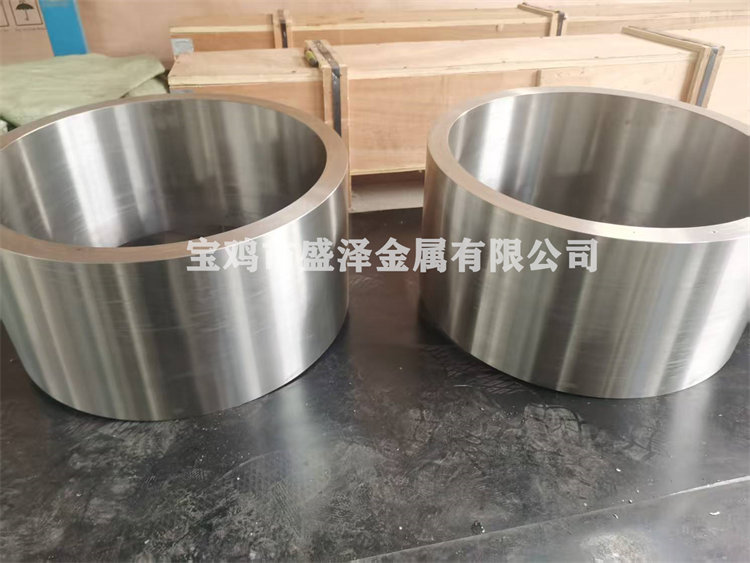
Titanium and titanium alloys have many excellent properties
1. High strength. Titanium alloy has high strength, with a tensile strength of 686-1176 MPa, and a density of only about 60% of steel, so its specific strength is very high.
2. High hardness. The hardness HRC of titanium alloy (annealed state) is 32-38.
3. Low elastic modulus. The elastic modulus of titanium alloy (annealed state) is 1.078 × 10-1.176 × 10MPa, which is about half of that of steel and stainless steel.
4. Excellent high and low temperature performance. At high temperatures, titanium alloys can still maintain good mechanical properties, with much higher heat resistance than aluminum alloys, and a wider working temperature range. Currently, the working temperature of new heat-resistant titanium alloys can reach 550-600 ℃; At low temperatures, the strength of titanium alloys actually increases compared to at room temperature, and they have good toughness. Low temperature titanium alloys can maintain good toughness even at -253 ℃.
5. Titanium has strong corrosion resistance. Titanium rapidly forms a thin and dense titanium oxide film on its surface in air below 550 ℃. Therefore, its corrosion resistance is superior to most stainless steels in oxidizing media such as atmosphere, seawater, nitric acid, sulfuric acid, and strong alkali.
2. New processes, technologies, and applications of titanium
2.1 Preparation method of titanium
Although titanium is relatively abundant in nature, it is also a rare metal due to its dispersion and difficulty in extraction. At present, the preparation of titanium can be divided into two categories: thermal reduction method and molten salt electrolysis method.
(1) Preparation of titanium by thermal reduction method
The thermal reduction method is to use strong reducing agents such as Li, Na, Mg, Ca, and their hydrides at a certain temperature to reduce titanium from titanium compounds such as TiCl4, TiO2, K2TiF6, etc. According to different titanium compounds, the technology of preparing titanium by thermal reduction can be divided into three categories:
① The oxidation-reduction methods of titanium chloride, such as Kroll method, Hunter method, Armstrong method, EMR method, etc;
② Oxidation reduction methods of titanium oxides, such as OS method, PRP process, MHR method, etc
③ Oxidation reduction method of titanates.
At present, only Kroll method and Hunter method can be successfully applied in industrial production. The Kroll method uses magnesium metal to replace titanium in chloride, while the Hunter method uses sodium metal to replace titanium in chloride. In addition, Chicago, USA The Armstrong method developed by Titanium Powder Company is similar to the Hunter method in its preparation, which also uses the reducing agent sodium to purify titanium metal. The United States has started using this method for pre production in factories.
(2) Preparation of titanium by molten salt electrolysis method
In 1959, Kroll predicted that molten salt electrolysis would replace the Kroll method as the mainstream method for producing titanium in the next 5-10 years. Over the years, domestic and foreign research institutions and laboratories have developed more than ten new technologies for preparing titanium by molten salt electrolysis. They can be divided into the following three categories based on raw materials:
① Electrolytic method of titanate;
② Electrolytic method of titanium chloride;
③ The electrolysis methods of titanium oxides include FFC Cambridge process, MER process, USTB process, QIT process, SOM process, and ionic liquid electrolysis method.
2.2 New uses of titanium
Since the 1940s, the use of titanium has developed rapidly and is widely used in aircraft, rockets, missiles, artificial satellites, and more Aerospace, naval vessels, military, medical, and petrochemical industries. In research, it has been found that the human body contains a certain amount of titanium, which can stimulate phagocytic cells and enhance immune function. Therefore, many laboratories are committed to the development and application of biological titanium.
New processes, technologies, and applications of titanium alloys
3.1 Preparation method of titanium alloy
Traditional processing of titanium alloys generally involves melting and casting techniques The processing technology of. is divided into the following types:
(1) Near net forming technology;
(2) Wire friction welding technology;
(3) Superplastic forming technology;
(4) Computer simulation technology for material preparation and processing.
Near net forming technology includes methods such as laser forming, precision casting, precision forging, powder metallurgy, and spray forming. Powder metallurgy is a new process for manufacturing titanium components by using titanium powder or titanium alloy powder as raw materials, forming and sintering them. Firstly, the production of powder is usually carried out by mechanical alloying, using ball mills to vigorously impact, grind, and stir the raw materials. Then, the alloy that has already formed powder is pressed into shape using two pressing methods: pressure forming and pressureless forming. The purpose of this step is to produce a pressed embryo of a certain shape and size, and to give it a certain density and strength. Then, the produced raw material is subjected to discharge plasma sintering, and specific sintering power and pressing pressure are applied to the sintered powder using upper and lower die punches and energized electrodes. Through discharge activation, thermoplastic deformation, and cooling, high-performance titanium materials are produced. Then, the titanium alloy that has undergone plasma sintering is subjected to subsequent processing, usually heat treatment or plastic deformation.
3.2 New Applications of Titanium Alloy
Titanium alloys were widely used in the aerospace industry in the early days, mainly in the production of aircraft engines or pneumatic components. Later, with the continuous development of technology, titanium alloys have entered the lives of ordinary people, and they can also be found in factories or household devices. Nowadays, countries and institutions are competing to develop new titanium alloys with the characteristics of low cost and high performance. In recent years, the new development of titanium alloys has mainly focused on the following five aspects.
(1) Medical titanium alloy
Titanium alloy has a low density and good biocompatibility, making it an ideal medical material that can even be implanted into the human body. Previously, titanium alloys used in the medical field contained vanadium and aluminum, which could cause harm to the human body. However, in recent times, Japanese scholars have developed a new type of titanium alloy with good biocompatibility. However, this alloy has not yet been mass-produced, and it is believed that in the near future, such alloys will be developed Alloys can be widely used in daily life.
(2) Flame retardant titanium alloy
Titanium based alloys that can resist combustion under certain pressure, temperature, and air flow rate are flame retardant titanium alloys. The United States, Russia, and China have all developed new flame retardant titanium alloys, among which the United States has applied these titanium alloys to engines because they are insensitive to combustion and can greatly improve engine stability.
(3) High strength and toughness β - type
β - type titanium alloy has the characteristics of high strength, good weldability, and excellent cold and hot processing performance. The characteristics of the β - type titanium alloy prepared by researchers using this law are very obvious: good heat treatment performance, good plasticity, and good welding performance. And after solid solution aging treatment, its mechanical properties have been greatly improved. Currently, both Japan and Russia have prepared such titanium alloys.
(4) Titanium aluminum compound
Compared to general titanium alloys, titanium aluminum compounds have good high-temperature performance, good oxidation and creep resistance, and a lower density than general titanium alloys. These excellent characteristics are destined to trigger a new alloy craze for titanium aluminum compounds. At present, the United States has synthesized this new titanium aluminum compound alloy and is in mass production.
(5) High temperature titanium alloy
The titanium alloy prepared by combining rapid solidification method with powder metallurgy method using fiber-reinforced or particle reinforced composite materials has excellent high-temperature mechanical characteristics. The operating temperature limit of high-temperature titanium alloys is much higher than that of ordinary titanium alloys. At present, the United States has developed a new type of high-temperature titanium alloy.
(6) Titanium nickel alloy
The alloy composed of titanium and nickel is called a "memory alloy". This alloy is made into a predetermined shape, and after shaping treatment, if deformed by external force, it can be restored to its original appearance with just a little heating. This alloy can be used in various fields such as instruments, electronic devices, etc.
Conclusion
Titanium has many advantages that cannot be compared to other metals. With the progress of society and the development of technology, the application of titanium and titanium alloys will become more widespread. The demand for titanium and titanium alloys will continue to increase, and high production costs are one of the main reasons limiting the promotion and use of titanium and titanium alloys. Therefore, the development and application of low-cost, large-scale, and environmentally friendly continuous production processes are essential for the wider application of titanium and titanium alloys.
Note: Editing and forwarding are only for conveying information and do not represent the views of our company. If there is any infringement, please delete it!
【End】



 location: